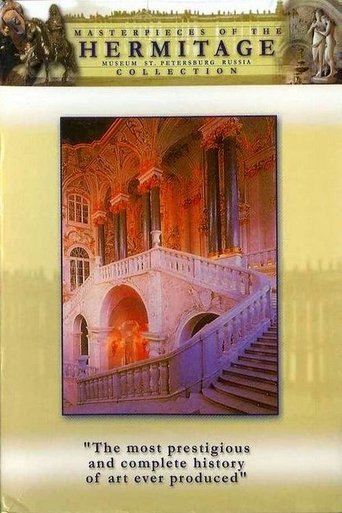
Hermitage Masterpieces

Season 1

A season summary is not currently available.

18 episodes · First aired 1992-01-01

Choose a season

Episodes

Page 1 of 1

Showing 18 at a time

S1 E130 min

The Museum's Majestic Architecture

In 1763, Catherine the Great ordered an addition to St. Petersburg, Russia's Winter Palace. Catherine called the Neo-Classical construction her "Hermitage". Over 250 years and several building expansions later, these impressive buildings house over three million pieces of art and the museum is considered one of the best and most important in the world.

S1 E227 min

The Vast Sculpture Collection

The Hermitage is home to all manner of sculpture. This episode features Rococo-style porcelain and relief works; Renaissance era sculpture that borrowed mythical animal motifs from the ancients; and marble Neo-Classical sculptures, whose creators were inspired by art uncovered during the excavations of Pompeii and Herculaneum in the mid 18th Century.

S1 E328 min

Highlights of the Masterpieces

It was Catherine the Great who assembled the heart of the Hermitage's painting collection. The Hermitage boasts an unrivalled collection of paintings: Rembrandt's portraits, Nicholas Poussin's grandiose narrative paintings, Pissaro's urban landscapes, Dutch still lifes, and Jan Steen's genre painting, to name but a few.

S1 E429 min

Decorative Arts of Italy, France & England

A look at the decorative works collected in the Hermitage Museum: furnishings, tapestries, pottery, porcelains, and silver. We are shown examples from several periods and areas: the Italian Renaissance, Spanish Majolica, Venetian glassware, Baroque ornamentation, Rococo cabinets and the Neo-Classical style.

S1 E529 min

Art from Mesopotania to Ancient China

A look at the Hermitage's collection of art and artefacts from India, China, and Mesopotamia. All these pieces are of great value to scholars who continue to be fascinated by the ideals, dreams, and beliefs of these civilizations.

S1 E627 min

Russia in the Age of Peter the Great

An examination of how Peter the Great transformed a little-used territory of Swedish swampland into the bustling City of St. Petersburg, home to the Hermitage Museum. The story of Peter's rule and legacy, the awakening of the Russian imagination, is depicted in detail in reliefs by Rastrelli, and etchings by Alexi Zubov.

S1 E726 min

The Art of Ancient Egypt

Catherine the Great acquired the first Egyptian relics for the Hermitage, now home to a comprehensive collection of nearly 10,000 pieces, some dating as far back as 4,000 B.C.

S1 E825 min

The Classical World of Greece and Rome

Democracy, logic, mathematics, science, and philosophy were all invented by the Greeks. Their influence on Western Civilization cannot be overstated. Their art, depicting ideal love and beauty, continues to fascinate. Many of the pieces in the Hermitage, never before seen outside of Russia, are shown and discussed in detail in this episode.

S1 E927 min

Art of the Middle Ages

The Hermitage boasts an extensive collection of Middle Age art, spanning ten centuries, from the 5th to the 15th. This episode examines the Romanesque statues of the period, and shows some of the ornate liturgical objects used in the church. Though less prevalent during this period, there are also examples of secular art, such as a bronze statuette of a knight hunting, and armour from the time.

S1 E1028 min

Art of the Early Italian Renaissance

Discover the age of the powerful Medici family, the "Golden Age" of Florence and the innovative paintings of artist like Fra Angelico, Simone Martini and Fra Filippo Lippi.

S1 E1129 min

The High Italian Renaissance

Leonardo da Vinci, Michelangelo, and the glittering array of Venetian painters produced works of miraculous originality and power. This brief period marks one of the highest peaks of the human spirit and artistic genius, and the collection of these works which you will see in the Hermitage is among the finest in the world.

S1 E1229 min

Art of the Netherlands: 15th & 16th Century

Trace the emergence of realism in the Netherlands as the elegant, aristocratic "International Style" gave way to dramatic light and brilliant color. A fresh, humanistic approach to painting was born, characterized by a new interest in portraiture and landscapes.

S1 E1328 min

17th Century Flemish Painting

The collection of Flemish and Dutch works housed in the Hermitage is now known around the world for its size and quality. Entrenched in Catholicism, these 17th century artists, such as Rubens and Van Dyck, painted in what became known as a Flemish Baroque style, which was extroverted and dynamic, inspired by heroic images from the antique age.

S1 E1428 min

Rembrandt & The 17th Century Dutch Masters

So vast is the Dutch collection of the Hermitage that one could trace this art's history solely from the works therein. The 17th Century saw a decline in patronage of the arts by church and state. Private collectors filled the void, and subject matter was changed to suit the new patrons who wanted portraits, landscapes, still-lifes, and genre paintings for their homes. We are also shown a selection of Rembrandt's work, outlining his movement towards a more Classical style.

S1 E1528 min

Velasquez, El Greco, Goya and the Spanish Masters

This episode examines the beginnings of Spanish Baroque painting. Religious paintings of the late 15th and early 16th centuries tackled questions of justice while the Inquisition went on around the artists. Some artists blossomed under Church patronage, others were persecuted as heretics. This episode shows works from artists such as Luis Morales, El Greco and Jose de Riebera.

S1 E1629 min

The French Classical Style of the 17th & 18th Centuries

Only because of Catherine the Great's desire to emulate the French Court was the Hermitage built as it was. As it stands now, it houses an unparalleled collection of 16th and 17th century French Classical works, with artists drawing on Greek and Roman myths for inspiration. At the end of the 18th century, we see the emergence of Romanticism, paintings stressing the awesome power and grandeur of nature.

S1 E1730 min

The Road to Impressionism: 19th Century France

It surprises some to discover that there are many Impressionist and Post Impressionist works in the Hermitage Museum by acknowledged masters such as Monet, Renoir, Pissaro, Degas, Van Gogh, Cezanne and Gauguin. This program covers the era from The Arts/Visual Arts French Academy Classical Style to the works of the Impressionists.

S1 E1826 min

Modernism: Matisse, Picasso & 20th Century Painting

At the dawn of the 20th century, the Impressionists were considered passé. In a critic at an exhibition in Paris described being amongst the pictures was as being amongst wild animals ("bêtes fauves" in French). The term Fauvism was born. In the Hermitage are works by André Derian, Kees van Dongen, and Henri Matisse.